This guide explains how to choose a humidifier for a U.S. room. Measure indoor humidity first, then compare the type, usable output, daily cleaning routine, and seasonal supply costs.
As an Amazon Associate, Winomax earns from qualifying purchases.

Table of Contents
1. Choose a humidifier only after measuring the room
Dry-feeling air during the heating season can make a humidifier seem like an obvious purchase, but comfort alone does not tell you the room’s relative humidity. A small digital hygrometer can help you measure it before spending money. If humidity is already adequate, adding more moisture may create condensation and encourage mold or dust mites.
The EPA advises keeping indoor relative humidity at or below 50% when using a humidifier. If windows or walls develop condensation, lower the setting or pause use. Cold windows can develop condensation even below 50%.
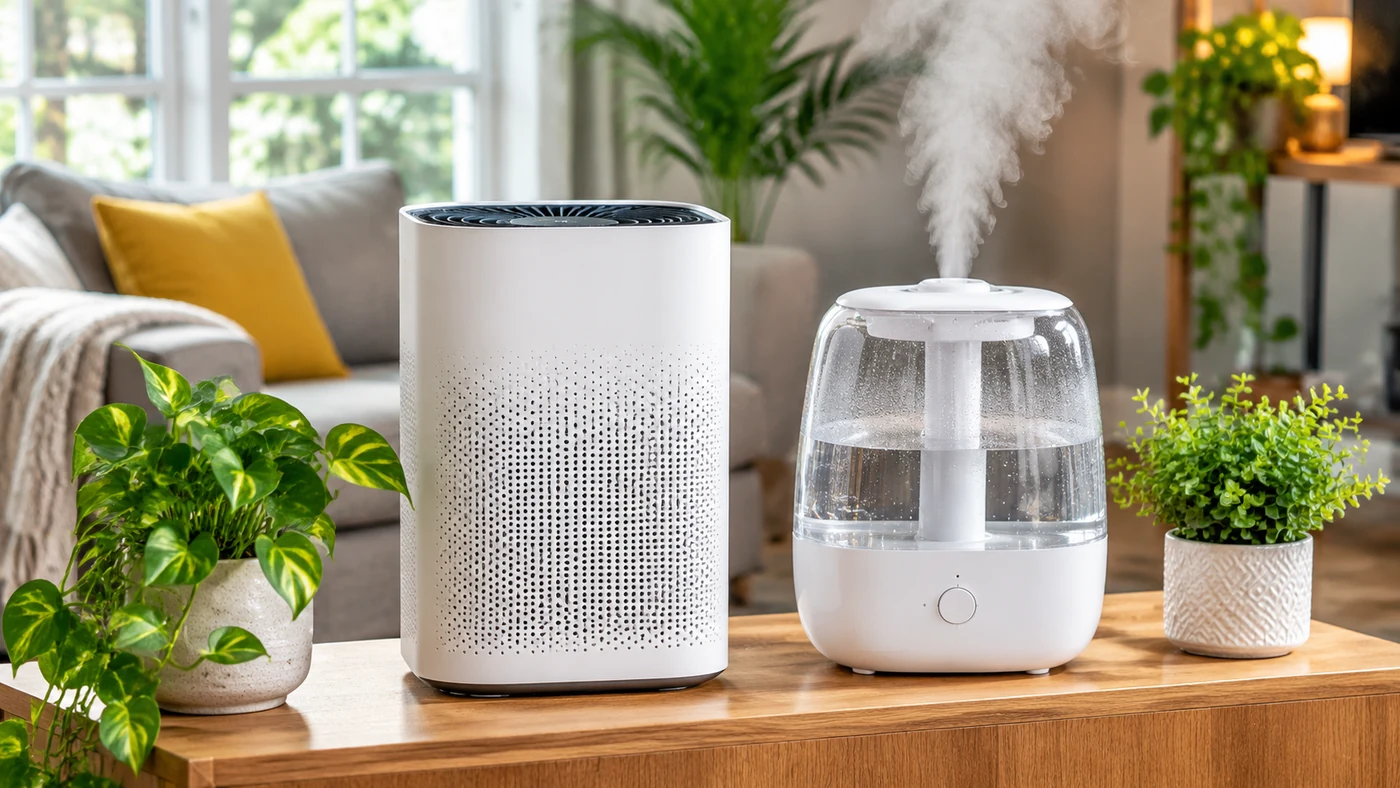
If you see recurring dampness or mold, address leaks, ventilation, or cold surfaces before buying a humidifier. See the EPA’s indoor moisture guidance. Still deciding whether your problem is moisture or particles? Use our air purifier versus humidifier comparison.
2. Compare the main types of humidifiers
Portable humidifiers add moisture in different ways. The technology affects noise, mineral residue, maintenance and safety. No type is best for every household; the right choice depends on your room, water, cleaning habits and who will be nearby.
Evaporative humidifiers
An evaporative model draws air through a wet wick, filter or similar absorbent material, usually with a fan. Water evaporates from the material into the moving air. These units generally have a fan you can hear, and the wick or filter needs periodic cleaning or replacement. Check the price and availability of replacement parts before buying, because a low purchase price can be offset by recurring filter costs.
Consider this type if you prefer a familiar fan-and-filter design and are comfortable maintaining the wick. Inspect how easily the filter compartment opens and whether the manufacturer sells replacements for the exact model.
Ultrasonic humidifiers
Ultrasonic models use high-frequency vibration to create a fine mist. Many are designed to operate quietly because they do not rely on a large fan, although noise varies by product and operating setting. Minerals in tap water can become airborne with the mist and settle as a fine white residue on nearby surfaces. Mineral content and the unit’s design influence how noticeable this is.
Check whether the manufacturer recommends distilled or demineralized water, a compatible cartridge, or a particular filter. Include the recurring cost and availability of those supplies in your comparison. For more detail, see our guide to distilled versus tap water in a humidifier.
Impeller or cool-mist humidifiers
Some cool-mist units use a rotating disk to break water into droplets. Like ultrasonic units, impeller models can disperse minerals and microorganisms from standing water, so water changes and careful cleaning matter. “Cool mist” describes the temperature of the moisture leaving the device; it does not identify one single technology. Read the product specifications to find out whether the unit is ultrasonic, impeller-based or evaporative.
Warm-mist humidifiers and steam vaporizers
These models heat water to produce steam or warm mist. Heating can reduce the amount of some minerals dispersed into the air, but it does not remove the need for cleaning. The main purchasing consideration is safety: hot water and steam can cause burns if a unit is tipped, touched or placed where a child or pet can reach it. They may also use more electricity than a comparable non-heating design, depending on the model and usage.
For rooms used by children, Mayo Clinic favors cool-mist humidifiers because hot water or steam can burn. Follow the manufacturer’s placement instructions and keep the appliance out of reach.
Whole-house humidifiers
A whole-house humidifier is connected to a home’s heating, ventilation or plumbing system and is different from a portable room unit. It may be worth investigating when moisture needs to be managed across several rooms, but installation, compatibility, drainage and maintenance are more involved. Ask a qualified HVAC professional to assess the system and explain ongoing servicing before committing to one.
3. Humidifier types compared
| Type | How it works | What to consider | Potential drawback |
|---|---|---|---|
| Evaporative | Fan moves air through a wet wick or filter | Replacement wick cost, filter access, fan settings | Fan noise and recurring filter maintenance |
| Ultrasonic | Vibration creates a fine mist | Water quality, cartridge cost, cleaning access | Mineral residue may appear with mineral-rich water |
| Impeller | Rotating disk creates droplets | Cleaning routine and water changes | Can disperse minerals or microorganisms if poorly maintained |
| Warm mist / steam | Heats water to create steam or warm mist | Stable placement, child safety, energy use | Hot water and steam can cause burns |
| Whole-house | Integrated with home HVAC | Professional assessment, installation and servicing | Higher installation complexity and cost |
For a bedroom, eliminate designs that will be disruptive at the setting you expect to use. For frequent hard-water use, compare the cost of a reliable wick supply with a season of low-mineral water. The table compares design and maintenance trade-offs. Exact output, noise, power, and service intervals depend on the model.
4. Choose the right size for your room
Manufacturers often publish a recommended room area or coverage range. Use it as a first filter, not a promise that the unit will maintain a particular humidity in every home. Ceiling height, open doorways, ventilation, insulation, outdoor temperature, starting humidity and the location of the device can all affect results.
Measure the room you actually want to humidify. A bedroom with a closed door is different from an open-plan living and dining area. If a product’s coverage rating is based on a smaller or more enclosed room than yours, it may struggle to keep up. Conversely, an oversized unit running at high output in a small room can make nearby surfaces damp if humidity is not monitored.
Worked example: A 12 × 14 ft bedroom has 168 sq ft of floor area (about 15.6 m²). If the door stays open to a 10 × 12 ft adjoining room, the combined area is 288 sq ft (about 26.8 m²). Compare those figures with the manufacturer’s stated coverage and check both spaces with a hygrometer. Airflow, room layout and ceiling height affect how evenly moisture spreads.
| Situation | What to check | Trade-off |
|---|---|---|
| Closed bedroom | Room coverage, noise at your preferred setting and a display you can dim. | A smaller tank is easier to lift and may need more refills. |
| Open living area | Coverage for connected spaces, adjustable output and humidity readings away from the mist. | A larger tank takes more effort to carry and clean. Moisture may spread unevenly. |
| Hard tap water | The water specified in the manual and the price of the exact replacement wick or cartridge. | Compare replacement wicks with the cost of distilled water or compatible cartridges. |
Tank capacity tells you how much water the unit can hold; it does not by itself tell you how effectively it humidifies a room. Runtime claims also depend on output setting and conditions. Compare the stated runtime at the setting you expect to use, not just the maximum number in an advertisement.
Estimate how many refills you can actually live with
Suppose a 3-liter tank feeds a device at 300 mL per hour. Dividing 3,000 mL by 300 mL per hour gives 10 hours at that rate under idealized conditions. A usable fill of 2.4 liters at the same rate gives eight hours. The water left behind when the unit shuts off, automatic cycling, and a different setting can change what happens at home. If a store advertises 30 hours but gives no output at that setting, leave the number out of your direct comparison.
Lift and handle the tank before deciding whether more capacity is worth the space. A buyer who fills a tank in a shallow bathroom sink might prefer a smaller unit or a design that takes water from a pitcher. The trade-off is more frequent refilling. A clear route to the sink and access to the base often matter more than an extra hour of theoretical runtime.
5. Check the humidity controls
A built-in humidistat measures relative humidity and may allow the unit to stop or adjust output when it reaches a chosen setting. This can be convenient, but sensor placement and accuracy vary. A separate hygrometer placed away from the mist can help you check the room rather than relying only on the reading shown on the appliance. For help comparing sensor accuracy, display features, calibration, and placement, see our guide to choosing a home hygrometer.
Useful controls may include more than one output level, an automatic mode, a low-water shutoff and a timer. Treat app connectivity, mood lighting and complex presets as optional extras. Pay for them only if they solve a real problem in your routine.
Most importantly, watch the room. If windows, walls, curtains or nearby furniture become damp, turn the output down, move the device as the manual allows, or stop using it. Do not aim the mist directly at a wall, bedding, electronics or wooden furniture.

6. Understand water quality and white dust
Check which water the manual recommends for the exact model. For a comparison of water types and ways to reduce mineral deposits, see our guide to water for humidifiers.
7. Maintenance: the cost and effort you should plan for
Every portable humidifier needs regular care. A model with a narrow opening, hidden corners or parts that cannot be removed may be frustrating to clean, even if its feature list looks impressive. Before buying, look at the tank and base design and check whether you can reach every surface that contacts water.
The EPA recommends emptying portable humidifiers daily, wiping surfaces dry and refilling with clean water; it also recommends cleaning portable units every third day. Mayo Clinic gives similar advice and stresses following the manufacturer’s cleaning instructions. Treat these as general guidance, not permission to ignore a stricter product manual. Always unplug the unit before cleaning, use only approved cleaning products, and rinse thoroughly as directed.
- Can the tank opening fit your hand or a cleaning brush?
- Can you remove the tank and access the base without spilling water?
- Are there corners or channels where residue can collect?
- Does the unit use a wick, filter, cartridge or other replaceable part?
- Can you buy the correct replacement part locally or online?
- Are cleaning instructions clear and realistic for your schedule?
Do not leave standing water in the tank between uses. Empty it, dry the accessible surfaces and refill with fresh water when you are ready to use it again. Follow the product manual for descaling, disinfection and filter replacement. Never mix cleaning chemicals, and do not use a disinfectant that the manufacturer has not approved for the appliance.
8. Calculate the real cost of ownership
The shelf price is only one part of the cost. A practical comparison should include:
- Purchase price: compare models with similar room coverage and functions rather than comparing unrelated sizes.
- Filters and wicks: check replacement price, recommended interval and availability.
- Water: estimate the cost if the manual calls for distilled or demineralized water.
- Electricity: check the rated wattage. For a rough estimate, multiply kilowatts by hours of use and your electricity rate. Actual consumption depends on settings and cycling.
- Replacement parts: consider cartridges, tanks or other components that may need replacing.
- Warranty and returns: read what is covered, for how long, and who pays shipping or service costs.
A larger tank may reduce refill frequency, but it can be heavier and harder to wash. A low-priced ultrasonic unit may require a regular supply of distilled water or cartridges. An evaporative unit may need replacement wicks. Compare the costs over the period you expect to own the product rather than choosing by purchase price alone.
Example seasonal cost: A unit averaging 40 W for 8 hours per night over 120 nights uses 38.4 kWh. At $0.15 per kWh, electricity costs $5.76. If the unit goes through 1 liter of distilled water per night at $1 per liter, add $120. For a unit that uses tap water and two $12 replacement wicks, the wicks add $24. Use the wattage or measured draw at your chosen setting, your local rates and the manufacturer’s maintenance schedule.
Compare service costs in the first and second season
Use the first winter to compare purchase price plus the maintenance items you will need by spring. For the following winter, remove the upfront cost and include replacement parts that are due then. Suppose one design is $20 cheaper upfront but needs an additional $45 of suitable water beyond the other design’s cost for replacement wicks each winter. Under those assumptions, the initial $20 savings is gone after the first winter and the other design is $25 less expensive by spring. Confirm the units deliver acceptable humidity in the same room before comparing dollars.
Consider the availability of supplies as well as the total. If your store carries replacement filters only seasonally, note the exact part number and see whether the maker ships it. If suitable water is the main cost, estimate consumption from what you refill over a normal week. This keeps a comparison from charging you for a whole tank on nights when you use only a quarter of it.
9. Features worth paying attention to
| Feature | Why it may matter | What to verify |
|---|---|---|
| Humidistat | Helps manage a target humidity level | Sensor location, adjustable range and auto control behavior |
| Auto shutoff | Can stop operation when water is low | Confirm the manual explains when it activates |
| Low-noise mode | Useful in bedrooms or quiet spaces | Listen to reviews cautiously; compare measured noise only under similar conditions |
| Wide tank opening | Makes cleaning and refilling easier | Check whether all water-contact surfaces are reachable |
| Dim display | Can reduce light in a bedroom | Check whether the display can be fully turned off |
| Filter indicator | Can remind you to inspect or replace a filter | Check whether the interval is time-based and still requires visual inspection |
Do not assume that a smart feature guarantees better humidity control or cleaner air. Focus on functions that support safe operation, maintenance and the way you will actually use the appliance.
10. Safety considerations for households
Place the humidifier on a firm, level, water-resistant surface where it cannot be knocked over. Keep the cord out of walkways and follow the manufacturer’s clearance instructions. Avoid placing the unit where mist can wet electrical equipment, walls, curtains, books or wooden furniture.
Warm-mist and steam models contain hot water and can cause scalds or burns if tipped or touched. The Mayo Clinic recommends cool-mist humidifiers for children for this reason. Cool-mist units still need careful cleaning because standing water and mineral deposits can create hygiene concerns. Keep all humidifiers out of children’s reach and supervise use around pets.
Stop using a unit if it leaks, has a damaged cord, smells unusual, develops visible buildup that cannot be removed, or causes persistent dampness around it. Follow the manufacturer’s troubleshooting and service instructions. If you believe using a humidifier is associated with respiratory symptoms, stop using it and seek appropriate medical advice.
11. How to compare two humidifier manuals
- Match the exact model number. Retail listings can group several versions under one name.
- Compare the setting you’ll use. Look for output in mL/h and runtime at that output. Check how the manufacturer determined the coverage. Leave missing figures blank.
- Check what you can clean and replace. Look at the tank and base diagrams. Find the part number and local price of any replacement filter, wick or cartridge.
- Check the return window. Use a separate hygrometer to see how the room responds while you can still return the unit.
12. Frequently asked questions
What size humidifier do I need for my bedroom?
Measure the room and compare it with the manufacturer’s stated coverage. Consider ceiling height, whether the door stays open, ventilation and the room’s existing humidity. Do not rely on tank capacity as a substitute for a coverage rating.
Is an ultrasonic humidifier better than an evaporative one?
Neither is universally better. Ultrasonic models can be quiet but may disperse minerals from tap water. Evaporative models use a fan and wick or filter, which creates a different noise and maintenance trade-off. Choose based on your water, room and cleaning routine.
How often should I clean a portable humidifier?
Follow the manufacturer’s instructions. The EPA recommends cleaning portable humidifiers every third day and changing the water daily. Unplug the device first, use only approved cleaning products and rinse it as directed.
What humidity level should I set?
The EPA advises keeping indoor relative humidity at or below 50% when using a humidifier. If windows or walls develop condensation, lower the setting or pause use.
Are warm-mist humidifiers safe around children?
Hot water and steam can cause burns. Mayo Clinic advises using cool-mist humidifiers for children. Keep any appliance out of reach and follow its safety instructions.
Does a bigger water tank mean a better humidifier?
No. A larger tank may mean fewer refills, but it can be heavier and harder to clean. Compare room coverage, runtime at the setting you will use, tank access and cleaning effort.
Can I add essential oils to the water?
Only if the manufacturer explicitly designed the unit for that use and explains how to do it. Oils and other additives can damage some appliances or create unwanted exposure. Do not add medication, fragrance or disinfectant to a water tank unless the manual specifically permits it.
Where should I place a humidifier?
Use a stable, level, water-resistant surface and follow the required clearances in the manual. Keep mist away from walls, windows, electronics, bedding and other items that should remain dry. Do not place it where children or pets can pull it over.
Our verdict
A good humidifier purchase is not about choosing the most powerful device or the longest feature list. It is about matching the technology and coverage to the room, controlling humidity with a reliable reading, understanding water requirements, and choosing a design you can clean consistently. Check the manual, warranty and replacement-part costs before you buy.
If you are still comparing home air products, read our guide to air purifiers versus humidifiers to understand the different jobs these appliances do. For more detail on our process, see how we research products and our editorial policy.
A baby’s room needs a more safety-focused selection process than a general bedroom. Read How to Choose a Humidifier for a Baby’s Room for cool-mist design, cleaning access, water choice, and safe placement.