
A soccer ball that works for an adult league can be the wrong size for a young player, and a futsal ball behaves differently from one used on grass. This guide helps U.S. families, recreational players, and volunteer coaches choose the correct size, construction, and playing-surface designation before buying.
Table of Contents
1. Soccer ball size: confirm the league’s age requirement before you buy
Ask your league or coach which ball size applies to the specific age division and season. Youth programs can use different names, cutoffs, and modified rules. A player’s age at the time you buy the ball may differ from the age group the league assigns. If a child plays for a school and in a separate recreational league, check both. The ball that comes in a starter bundle is only a good deal if it matches the group that will use it.
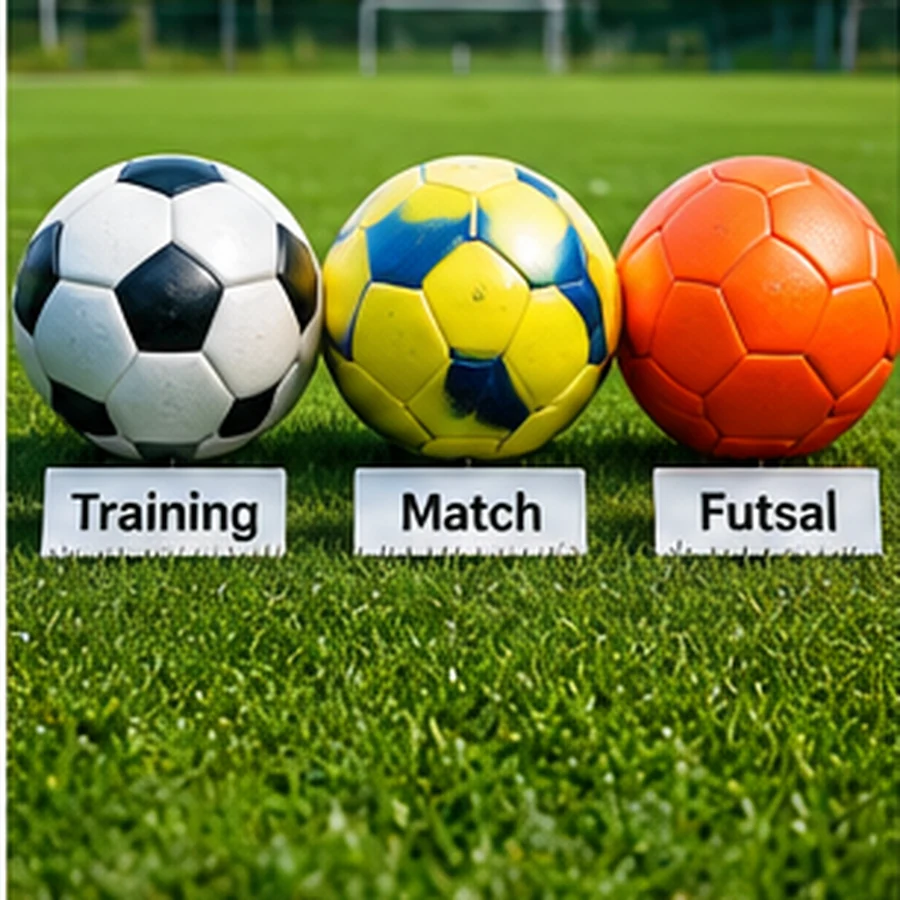
Retail charts give a practical starting point when no league is involved. For example, Nike’s U.S. ball size chart maps size 3 to ages seven and under, size 4 to ages eight through twelve, and size 5 to ages thirteen and older. Use those ranges as the manufacturer’s shopping guidance. Your coach may have a different cutoff, and age alone does not tell you whether a specific ball is approved for a competition. Where the league and a package label differ, use the league rule.
For standard outdoor play, the International Football Association Board’s Law 2 specifies a circumference of 68–70 cm and a weight of 410–450 g at the start of the match, along with a pressure range. Local youth and recreational programs may operate under modifications. If you are buying on behalf of a team, get the rule or an approved-ball list in writing before placing a bulk order. A size designation is useful for filtering a catalog. Eligibility can depend on more than size.
2. Pick the category that matches actual use
| Setting | First choice to compare | What to verify |
|---|---|---|
| Youth team practice on grass | Training ball in the team’s required size | Division, intended surfaces, inflation range, and whether the coach provides balls. |
| Adult outdoor recreation | Size 5 outdoor training ball when the league calls for it | Whether practices are primarily on natural grass or artificial turf. |
| League or tournament match | Ball approved by the competition organizer | Approval mark, model, and who supplies the match ball. |
| Indoor futsal court | Program-approved lower-bounce futsal ball | Size and weight specified by the indoor program or facility. |
| Frequent pavement practice | Ball explicitly listed for street or hard-surface use | Cover suitability for pavement and whether an indoor gym permits it. |
Use the row that represents most of your playing time. If you practice on outdoor turf twice a week but visit a futsal court four times each winter, buy the outdoor practice ball first and ask whether the indoor program supplies balls. If you play mostly on hard courts, an outdoor ball that happens to be the correct size can still bounce differently from the ball you are expected to use. FIFA’s futsal introduction describes the format and the characteristic lower-bounce ball.
Indoor soccer is also a broad label. One facility may play futsal on a hard court, while another uses indoor artificial turf and rules closer to outdoor soccer. Ask the facility what it allows before assuming that an indoor label describes the right type. For a gym, it is worth asking whether outdoor-used balls are permitted, since a facility may restrict what can be brought onto the floor.
3. Compare training, match, and street balls
A training ball is a reasonable default when the buyer needs one ball for repeated practice. For a team drill, consistency matters more than the word “premium” on the package. If several balls will be used interchangeably, compare the exact versions and sizes before ordering. Check that the replacement model will be available if one goes missing. A common training model your club can reorder is often easier to manage than a sale bundle containing several unrelated ball types.
A match ball is worth considering when the organizer requires it, the coach wants practice to match competition conditions closely, or you have a specific reason to prefer a documented model. Ask what the league supplies before buying. A parent can spend extra on a ball that the coach has already provided for games, while the child still needs a personal training ball for practice. A buyer comparing tournament equipment should check the required approval, not assume that a model described as “match quality” in a marketplace title qualifies.
A street ball makes sense when pavement is the dominant surface and the seller or manufacturer identifies that surface as an intended use. Friction and contact with rough ground are different from what a ball encounters on grass. Look at the listing for guidance on the surface, and check whether the warranty excludes the way you expect to play. If you move among grass, a concrete yard, and a polished court, keep the facility’s requirements in view instead of trying to make one ball serve every setting.
Seller labels can group several finishes or variants on one page. Check the product name, exact size, and intended surface after choosing the color or size menu. If the description changes or a photo shows a different size, ask the seller or choose a listing with clearer specifications. At delivery, compare the markings on the ball and its packaging with what you ordered while it is still eligible for a return. A trial on rough pavement can complicate returning an unused item.
4. Check the specifications that affect daily use
Cover, panels, and construction
Read how the manufacturer describes the outer cover and panel construction. Two balls with similar graphics can be built differently. A construction label can explain how panels are joined, but it is not an independent durability test. Compare a documented use case and a realistic return policy before ranking one ball above another on construction alone. If an independent test is available for the exact version, check whether it used the same surface and a similar playing schedule. A claim about performance on grass may tell a coach little about a ball’s life on a concrete yard.
For young players, also distinguish a smaller size from a product advertised as lightweight. The words can describe different dimensions or weight choices. If a program specifies both size and weight, confirm both against the listing or the markings. A novelty mini ball can be fun for footwork at home, but do not buy it as a substitute for the size a coach asks players to bring.
Inflation and storage
Read the pressure printed on the exact ball or in its instructions. Use a compatible pump and pressure gauge and follow the manufacturer’s directions for the valve and needle. An outdoor match-law pressure range is a rule for that category, while a specific practice ball can carry its own recommended range. Check the units on the ball and gauge before inflating. If the ball is shipped partly deflated, plan time to set it up before the first practice.
When comparing two balls, check the pressure on both before judging feel. A ball that seems exceptionally hard or soft might simply be at a different pressure. Record where you measured it and compare under similar conditions. If pressure falls unusually quickly after you follow the instructions, inspect the valve and consult the seller while the return window is open. If you coach, do this before putting your whole order into circulation.
Check whether you already have a pump, compatible needles, and a way to store and carry the ball. A family buying one ball can share a pump among several sports if the maker confirms compatibility. A coach may want a gauge and spare needles in the team bag so the same person does not have to inflate every ball at home. Use the storage guidance supplied with the ball and clean off dirt before it goes into a bag with clothing or footwear.
5. Work through three common buying situations
A first-season player about to move up an age group
Suppose your child plays in a division that requires size 3 and will move to a division that uses size 4 after the season. First, ask whether the coach provides balls and whether bringing one is expected. If you need a ball now and your child will practice at home every week, get the correct size for this season. A borrowed ball that fits the current program may make more sense if there are only two practices left. Buying the larger ball early means the child may turn up with equipment the coach will ask them to leave in the bag.
At home, decide how you will use the old ball once the player moves up. A younger sibling may inherit it, or the program may accept a donation in usable condition. Those choices make it easier to justify buying the correct current size instead of guessing that one ball should last through several divisions. If the rules change across programs, verify the new size before making a gift purchase around the child’s birthday.
An adult team practicing on an artificial field
Suppose a recreational team trains on artificial turf and plays official games on grass. The organizer supplies an approved match ball. In that situation, the team needs practice balls for the artificial field first. Compare manufacturer guidance for that surface and choose the size the team uses in games, if applicable. If you want the team to warm up with the same feel on game day, ask the league which exact ball is supplied and consider using one for selected drills. A whole bag of premium match balls may be unnecessary for routine training where loss, storage, and replacement are the main costs.
A family choosing between an outdoor ball and a futsal ball
A child attends a futsal class twice a week and plays outdoor soccer with friends occasionally. Ask the class whether it supplies balls and what is required for home practice. If the player mainly wants to repeat futsal drills on a permitted court, get the class-compatible futsal ball. For pickup on grass, borrow or budget separately for the appropriate outdoor ball if needed. Choose according to where the ball will be used more often and whether there is a safe, appropriate surface available to practice on.
6. Compare total cost over the season
Put two options on the same basis before comparing advertised prices. Include how many usable balls the order gives you, how much you spend on a pump or bag, and the likely number of replacements. If a discount requires a membership, evaluate the total at checkout with the membership cost and shipping where relevant. If you are ordering for a league, ask how the seller handles quality problems when only one ball in a multi-ball shipment is affected.
Take an illustrative eight-ball practice order. At $22 per training ball, the balls cost $176. Add $19 for a pump and needles and $25 for the bag, and the starting cost is $220 before tax and shipping. If the team expects to replace two balls at $22 each, the example season totals $264. A competing order of eight balls at $27 each with the same accessories totals $260 initially. If the team replaces one ball at $27, season cost becomes $287. These are planning figures in USD, not offers or forecasts about durability. The point is to enter replacement assumptions explicitly rather than assuming that the advertised unit price is the end of the calculation.
Now apply the same arithmetic to a young player who needs only one ball. If you already have a suitable pump and needle, subtract the entire accessory amount you do not need. If the coach lends balls, the purchase decision could wait until the child is practicing outside of team activities. A household also needs to consider where a ball can be used. A low price on a second ball is less valuable if you have no suitable space to use it. For used equipment, check the condition in person when possible and inspect the cover, seams, valve, and size markings before paying.
Check a team order before handing it out
For a team order, inspect the shipment while you still have time to return it. Check the size printed on each ball, group identical models, and set aside any that appear to differ from the listing. Inflate a sample from each group to the recommended pressure before evaluating how it rolls and rebounds on the intended field. Keep packaging and order details until the bags are ready. This quick acceptance check gives you time to resolve a mixed-size box before a season begins. If several adults share responsibility for the equipment, keep the model name and needle or pump instructions with the bag so anyone can handle a routine refill.
7. Frequently asked questions
Is size 5 right for every adult?
Size 5 is the usual starting point for standard outdoor adult soccer. Check any facility or league-specific rule, especially for futsal or another modified format. If you want a ball for a particular tournament, confirm the tournament’s requirements and whether it provides the match balls.
Can I use a futsal ball for regular outdoor practice?
It may be useful for a drill if your coach specifically asks for one. For ordinary outdoor play, choose a ball that matches your league’s expected behavior, size, and surface. The futsal ball is designed for a different format and characteristically bounces less. If both formats matter, decide which one the purchase needs to serve before comparing prices.
Can I tell quality by squeezing a ball in the store?
Squeezing can reveal obvious softness or visible damage. Check inflation before treating surface feel as a quality comparison. Look at the actual product specification and ask what the store allows you to inspect. A display ball that has been deflated for shipping or sitting for weeks can feel different from the same model prepared according to its instructions.
Is one ball enough for a young beginner?
Usually one correctly sized ball for the main surface is enough to start if the coach expects the player to bring one. Ask what the program supplies. Consider a second ball when the player has a distinct use, such as regular futsal, or when storage and scheduling make a shared household ball impractical.
Browse more equipment advice in our Sports & Outdoors buying guides.
Our verdict
Use your program’s size and surface rules to narrow the search. For frequent outdoor practice, buy a training ball that the manufacturer lists for the surface you use. For futsal, choose a futsal-specific ball that meets the program’s specifications. For a match, check what the organizer supplies and which approval it requires. If a borrowed or existing ball meets the same need, test it first and spend only when you can name what it lacks.

One thought on “How to Choose a Soccer Ball by Age and Playing Surface”