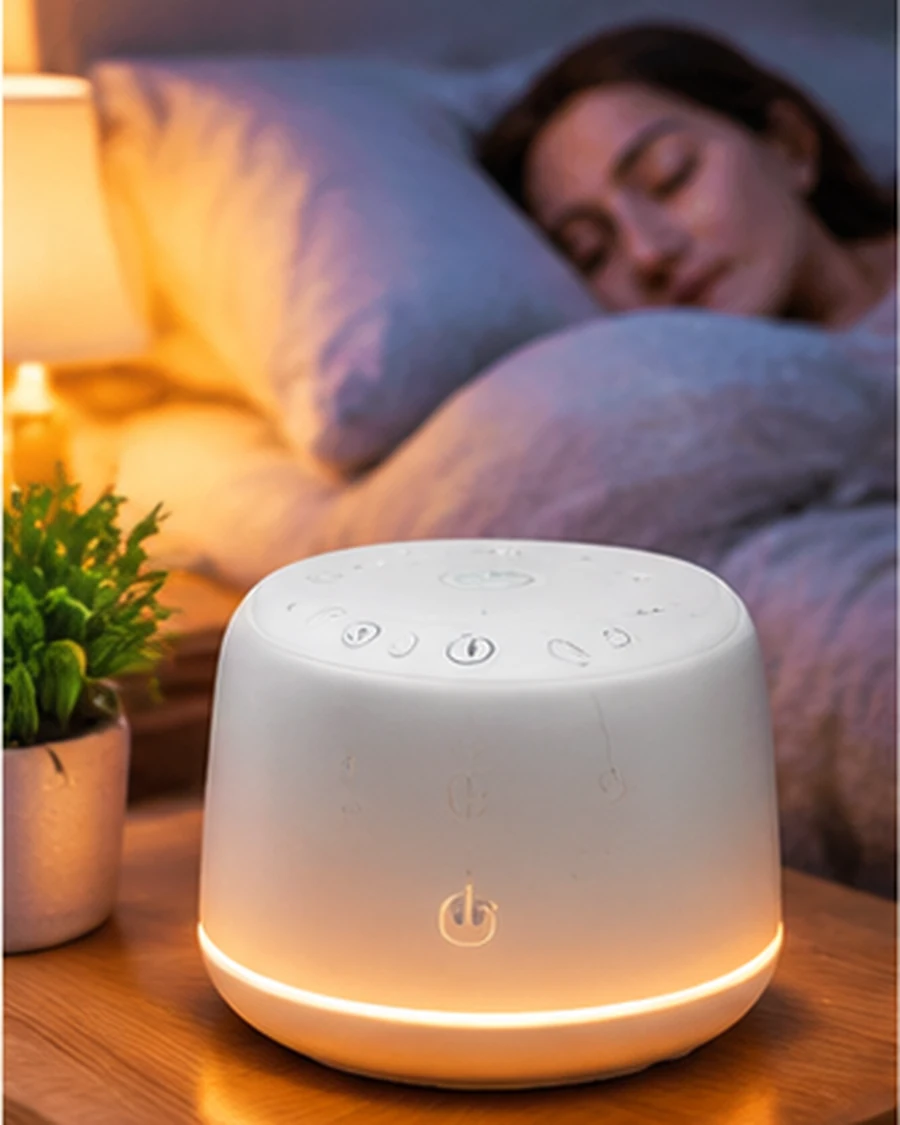
A white noise machine can make a bedroom, nursery or shared workspace feel more consistent by adding a steady background sound that masks some sudden environmental noise. The right model is not necessarily the one with the most sound options or the highest volume. Sound quality, volume control, timer behavior, power, portability, ease of use and safe placement matter more. A machine intended for an adult bedroom may not be the right choice for an infant’s sleep space, where sound exposure deserves extra caution.
As an Amazon Associate, Winomax earns from qualifying purchases.
Compare sound machines and portable options on Amazon
Bedroom sound machines
Portable sound machines
Nursery sound machines
Table of Contents
1. White noise machine basics: understand what it does
A white noise machine produces a steady sound that can make sudden changes in the surrounding environment less noticeable. A passing truck, hallway conversation, door closing or intermittent household noise may stand out less when a consistent background sound is present. This is called sound masking. It does not remove the source of the noise, soundproof the room or guarantee that a person will fall asleep.
The term white noise is often used broadly in product listings. Some devices produce a true white-noise signal, while others play fan sounds, rainfall, ocean sounds, nature recordings or synthesized tones. Those sounds can serve a similar masking purpose, but they are not all technically white noise. Compare the sound you actually hear rather than relying on the category name printed on the box.
A sound machine may be used in a bedroom, nursery, hotel room, dorm, shared apartment or workspace. The best fit depends on the noise you are trying to mask. A low, steady fan-like sound may help cover traffic rumble, while a different sound may be more comfortable for voices or intermittent hallway noise. The goal is not to make the room loud. It is to choose a quiet background that feels consistent and does not become a distraction.
Be realistic about what the device can do. A sound machine cannot treat insomnia, anxiety, tinnitus, sleep apnea or another health condition. It cannot replace a quiet room, a consistent sleep schedule or appropriate medical care. If sleep problems persist or affect daytime functioning, seek qualified advice rather than increasing the machine volume or buying more sound options.
2. Compare white, pink, brown and nature sounds
White noise is commonly described as a broad range of frequencies with equal power per frequency interval. To many listeners, it sounds like steady static or a fan. It can mask a range of background noises, but some people find the higher-frequency character too sharp. A device that offers several sound profiles lets you test whether white noise is comfortable at a low level.
Pink noise places relatively more energy in lower frequencies than white noise, which can make it sound softer or deeper to some listeners. Brown noise emphasizes lower frequencies further and may resemble a low rumble or distant wind. These labels describe sound characteristics, not proven sleep outcomes. A product should not claim that one color of noise is medically superior for every person.
Nature sounds such as rain, waves, wind or flowing water may feel more pleasant than a static-like signal. They can also contain changes in volume, rhythm or recording artifacts that some people notice. Listen for abrupt transitions, repeated birdsong, obvious loops or sudden peaks. A sound that is soothing for five minutes may become irritating after several hours if the recording repeats too obviously.
Fan sounds can be useful because they provide a steady, familiar background. Some machines use a physical fan or airflow; others play a recording or synthesized version. A real fan may also move air, but it can have moving parts and a mechanical hum. A digital fan sound does not circulate air. Do not buy a sound machine expecting it to cool or ventilate the room unless it is a separate fan product designed to do that.
The most useful feature is often the ability to audition sounds at a low volume. A large library is not valuable if the sounds are harsh, repetitive or difficult to adjust. Look for clear descriptions of the sound options and, where possible, a return policy that allows you to test the device in your own room. Your room acoustics, wall construction and the type of outside noise will influence the result.
| Sound type | Typical character | What to check |
|---|---|---|
| White noise | Broad, static-like or fan-like | Whether the higher frequencies feel comfortable |
| Pink noise | Often perceived as softer or fuller | Whether the sound stays even at low volume |
| Brown noise | Deeper, low-frequency emphasis | Whether low tones cause vibration or rumble in the room |
| Nature sounds | Rain, waves, wind or water | Loop quality, sudden peaks and recording changes |
| Fan sound | Steady mechanical or simulated airflow | Whether it is a real fan or only a recording |
3. Choose mechanical or digital sound
Mechanical sound machines use a fan, rotating disc or another physical mechanism to create a continuous sound. Their main advantage can be a naturally continuous signal without an obvious digital loop. The sound character may change slightly with the device design, and moving parts can create wear, dust buildup or a motor hum. Check whether the manufacturer provides cleaning instructions and whether the device is designed to run for long periods.
Digital machines play recorded or synthesized sounds through a speaker. They can offer more variety, smaller bodies, rechargeable batteries and timer options. The important detail is loop quality. A short recording that repeats every few seconds may create a noticeable click, pause or pattern. Look for descriptions of seamless playback and read reviews that mention whether the loop becomes obvious overnight.
Speaker quality matters even when the device is not used for music. A small speaker can distort at higher volumes or produce a harsh tone. The machine should sound smooth at the low level you plan to use. Do not judge it only by how loud it can get. A high maximum volume is not a useful advantage if the sound becomes unpleasant before it masks the noise in your room.
Some products combine a speaker with a real fan, night-light, clock, alarm or Bluetooth connection. These combinations can save space, but they also add controls and possible failure points. Decide which functions you genuinely need. If the sound machine is mainly for bedtime, a simple physical dial and one or two reliable sounds may be easier to use than a complicated app-driven device.
4. Set volume and placement safely
Start with the lowest volume that makes the background noise less noticeable. The sound should not compete with conversation, music or other activities. If you need to raise your voice to speak to someone nearby, the room is too loud for ordinary conversation and the machine is likely set higher than necessary. Do not use maximum volume as a shortcut for masking a problem that could be addressed at its source.
Place the machine away from your head rather than directly beside the pillow. Distance reduces the sound level that reaches the ear, although the exact reduction depends on the room and device. Avoid placing a speaker under a pillow, inside bedding or against the headboard near the sleeper’s ear. Do not block ventilation openings or cover the machine with fabric.
The CDC and NIOSH explain that noise risk depends on both loudness and exposure time. Their occupational guidance uses 85 dBA over an eight-hour workday as a recommended exposure limit; that figure is not a target for bedroom use. A sleep machine should be kept comfortably low, not tuned to an occupational threshold. If the sound causes ringing, discomfort, headaches or a feeling of pressure, turn it down or stop using it.
Do not assume a volume number on the device corresponds to a specific decibel level. A level setting of 3 on one machine may be louder than level 6 on another. Room size, speaker direction, wall reflections and distance all affect the sound at the ear. If you need a measurement, use a suitable sound-level meter and measure where the listener’s head will be, not directly beside the machine.
The machine should not replace basic noise control. Close a window, add a door seal, move a rattling appliance or use curtains and rugs where appropriate. If the noise is persistent, disruptive or unusually loud, identify its source. A sound machine can soften the perception of some background noise, but it cannot make an unsafe or unhealthy environment acceptable.
5. Apply extra care in a nursery
Infants need a more cautious approach because their ears are close to the sleep surface and they cannot move away from a loud sound source. The American Academy of Pediatrics has warned that infant sleep machines can produce sound levels that may be hazardous when placed close to a baby or used at high volume. HealthyChildren.org also advises placing sleep machines as far from the baby’s head as possible and using them for a short time only.
If a family chooses to use a sound machine in a nursery, place it well away from the crib, keep the volume at the lowest effective level and limit the duration. Do not put the device inside the crib, attach it to the crib rail near the baby’s head or place it under bedding. Follow the current advice from the child’s pediatrician and the product instructions. A machine marketed for babies is not automatically safe at every setting.
Check whether the device has a physical volume limit, timer and child-safe controls. A timer can reduce unnecessary overnight exposure, but it should not be treated as a substitute for safe placement and low volume. If the sound machine restarts at a louder setting after a power interruption, that behavior may be undesirable. Read the manual and test the settings before using it in the nursery.
Do not rely on a product’s maximum decibel claim without understanding how it was measured. The distance between the machine and the microphone, the sound setting and the room all matter. The AAP’s advice is about reducing exposure, not finding a high volume that masks every sound. If the baby has difficulty settling or there are concerns about hearing or sleep, discuss them with a pediatric clinician rather than turning up the device.
A sound machine is optional. It should not become a requirement for safe sleep or be used to cover up crying, breathing problems or other signs that a baby needs attention. Keep the sleep space clear and follow safe-sleep guidance from the child’s health-care provider. The machine belongs on a stable surface away from the crib, with cords secured so they cannot be reached.
6. Compare timers, controls and sound loops
A timer can be useful if you want the sound to stop after you fall asleep or after a set period. Some machines offer a short list of preset intervals; others allow continuous playback. Think about the routine you want. A timer that shuts off too early may wake you when outside noise returns, while continuous playback may be unnecessary for a short nap. The best option is the one you can set reliably.
Check whether the timer fades the sound gradually or stops abruptly. A sudden silence may be noticeable in a room where the machine is masking intermittent traffic or voices. A gradual fade can feel less abrupt, but it is a preference rather than a guaranteed sleep benefit. If the product listing does not explain timer behavior, look for the manual or ask the seller.
Physical controls are often easier to use in a dark room. A large dial, clearly marked buttons and a tactile volume control can be more practical than a touchscreen. Check whether the device remembers your last sound and volume setting. If it resets to a loud default every time it is unplugged, that may be inconvenient or unsafe for some users.
A display can show the timer, sound selection or volume, but bright digits may disturb a dark bedroom. Look for a dimmable display or an option to turn it off. Some machines have a night-light; check whether the light can be disabled independently of the sound. Do not assume a warm-colored light is automatically appropriate for every sleeper.
If you use the machine in a shared room, check whether it can start quietly without a loud button tone or spoken prompt. Some smart devices announce connection status or play a startup sound. Those small details can be irritating at night. Read reviews that describe actual overnight use, not just the sound library.
7. Check power, battery and portability
A plug-in machine is usually straightforward for a permanent bedroom setup. Check cord length, plug position and whether the device has a stable base. Keep cords away from walkways and secure them so they cannot be pulled from a bedside table. Do not use a damaged power cord or cover a power adapter with bedding.
A rechargeable model can be convenient for travel, hotel rooms, dorms or rooms without an outlet near the bed. Check the stated battery runtime at the volume you expect to use, not only the lowest setting. Battery performance can decline over time, and a sound machine that needs charging every night may become less convenient than a plug-in model.
If the machine uses replaceable batteries, confirm the battery type and whether the compartment is easy to access. For a nursery, make sure the battery compartment is secure and cannot be opened by a child. A USB-powered model may need a separate wall adapter, which can be an extra cost. Check whether the product includes the cable and adapter or only the device.
For travel, consider packed size, weight, battery rules and how the device is controlled. A compact machine with a physical volume dial may be easier to use in a hotel than a smart speaker that depends on Wi-Fi. If you use a phone app, check whether the sound can play without an internet connection and whether the machine can be controlled without unlocking the phone.
8. Decide whether lights and apps are useful
Some sound machines include a night-light, sunrise alarm, Bluetooth speaker, clock or app. These features can be convenient if they replace devices you already use, but they can also add light, notifications and setup complexity. Ask whether each feature solves a real problem. If you want only steady background sound, a simple machine may be more reliable and less expensive.
An app may allow you to create schedules, choose sounds or control volume remotely. Check whether the machine still works if the app is removed, the phone battery is empty or the manufacturer stops supporting the software. Look for a physical power and volume control so the basic function does not depend entirely on a smartphone.
Review privacy terms before connecting a sound machine to Wi-Fi or a voice assistant. Find out whether the device collects usage data, requires an account, records audio or shares information with third parties. A basic sound machine does not need a microphone to play a steady noise. If a smart device includes voice features, check whether the microphone can be disabled.
Bluetooth can be useful for playing a personal recording, but it is not essential for sound masking. Check whether the machine has a built-in sound library that works without a phone. A product that relies on streaming may stop playing if the connection drops. If you want uninterrupted overnight playback, a self-contained sound source may be simpler.
9. Match the machine to the room and routine
For a bedroom near traffic, test a steady sound that does not have sudden peaks. A deeper sound may feel less sharp, but the best option depends on the room and listener. Place the device away from the bed and start low. If outside noise is very loud, consider window seals, curtains or another source-control measure rather than increasing the volume indefinitely.
For a shared apartment, choose a machine with a smooth sound and precise volume control. A small speaker placed near the wall may reflect sound differently from one on a bedside table. Try a few positions before deciding the device is ineffective. Be considerate of other occupants, especially if the sound is audible through a shared wall.
For a dorm room or travel, portability and easy controls may matter more than a large sound library. A rechargeable machine can be useful, but verify battery runtime and charging options. A simple plug-in model may be more reliable if you always have an outlet near the bed. Consider whether you want to carry a dedicated sound machine or use a phone with a separate speaker, while keeping the phone away from the pillow.
For focused work, a sound machine can mask some office chatter or household interruptions, but a sound that helps one person concentrate may distract another. Choose a low level and avoid sounds with noticeable loops or changing patterns. If you work with calls or recordings, check whether the sound will be picked up by your microphone. You may prefer headphones or a quieter room for tasks that require clear audio.
If you are also improving bedroom comfort, remember that sound and air quality are separate issues. Our guide to choosing a humidifier explains how to compare room-humidity features. A humidifier does not mask noise, and a sound machine does not change humidity. Choose each device for the problem it is designed to address.
10. Calculate cost and support
Compare the purchase price with the features you will use. A basic machine may be enough if you need one steady sound, a timer and a physical volume control. A premium model may be worthwhile if it offers a reliable battery, high-quality speaker, seamless playback and accessible controls. Do not pay extra for a large library if you will use only one or two sounds.
Check whether the device requires a paid app, subscription or cloud account. A product that advertises dozens of sounds may provide only a limited selection without a subscription. Find out whether new sounds can be downloaded, whether the machine works offline and whether the app is still supported. The total cost may include an adapter, replacement battery or accessories.
Read the warranty and return policy. Sound quality is personal, so a reasonable return window can be valuable if the product does not suit your room. Check whether opened or used audio devices can be returned and whether shipping is deducted from the refund. Save the packaging until you have tested the volume, timer and power behavior.
A simple machine should still have a clear manufacturer, model number, manual and support contact. Check whether replacement adapters or batteries are available. If the machine uses a proprietary charging cable or app, consider what happens if that accessory is lost or the software is discontinued. Long-term support can matter more than a decorative feature.
11. A practical buying checklist
- Choose the sound character you find comfortable at a low volume.
- Check for seamless playback and listen for repeated loops, clicks or sudden peaks.
- Confirm that the volume can be adjusted precisely and starts at a safe level.
- Choose a timer or continuous mode that matches your routine.
- Place the device away from the sleeper’s head and keep cords secured.
- For infants, follow pediatric guidance on distance, lowest volume and limited duration.
- Check plug-in, USB or battery power and realistic runtime.
- Decide whether a night-light, app or Bluetooth feature is genuinely useful.
- Review privacy terms if the device connects to Wi-Fi or voice assistants.
- Read the warranty, return policy and any subscription requirements.
If you are choosing a machine for an infant, treat the safety guidance as a separate requirement rather than assuming the nursery label is enough. Keep the machine away from the crib, use the lowest effective volume and limit exposure. If you are choosing for an adult, use the same basic principle of starting low and avoiding unnecessary loudness.
12. Frequently asked questions
Does white noise help everyone sleep?
No. Some people find steady background sound helpful for masking intermittent noise, while others find it distracting. The response is personal, and a sound machine is not a treatment for a sleep disorder. Test a low volume and stop using it if it makes sleep or comfort worse.
What is the difference between white, pink and brown noise?
They describe different frequency balances. White noise is often perceived as brighter or more static-like, pink noise has relatively more lower-frequency energy, and brown noise emphasizes lower frequencies further. Product labels are not always precise, so listen to the actual sound.
Should a white noise machine run all night?
That depends on the user, the device and the volume. Adults may prefer a timer or continuous mode. For infants, pediatric guidance advises keeping the device far from the crib, using the lowest volume and limiting duration. Follow the current advice of the child’s clinician.
How far should a sound machine be from a baby?
Place it as far from the baby’s head and crib as practical, on a stable surface, and use the lowest volume for a limited time. Do not place it in the crib or attach it close to the baby. Follow current pediatric guidance rather than relying on a product’s marketing.
Is a fan better than a white noise machine?
A real fan can create steady sound and move air, while a sound machine may offer more sound choices and timer controls. The best option depends on the room, desired airflow, noise character and maintenance. A digital fan sound does not circulate air.
Can a white noise machine be too loud?
Yes. Sound exposure depends on loudness and duration. Keep the volume low, place the machine away from the head and avoid using maximum settings. If the sound is uncomfortable or you notice ringing or pressure, turn it down or stop using it.
Our verdict
The best white noise machine is one that produces a comfortable, consistent sound at a low volume and offers controls you can use without thinking. Prioritize smooth playback, precise volume adjustment, timer behavior, power options and a stable design. Choose sound types by listening, not by assuming that a particular color of noise is better for every person.
For adults, place the device away from your head and keep the level as low as practical. For infants, apply extra caution: follow pediatric guidance, keep the machine well away from the crib, use the lowest volume and limit duration. A sound machine should be a simple background tool, not a substitute for safe sleep practices, noise control or medical advice.